Whatsapp

+86 15633683072

微信号

Industrial Automation & Intelligence Solutions

Stock Code:831045

Current location:首页 > News > Industry Dynamics

Open vs Closed Orbital Welding Head | China Manufacturer

2026-04-09 15:37:36

If you’re shopping for an orbital welding head, you’ve probably noticed two distinct families: open and closed. Both are orbital welding heads. Both rotate around the pipe. Both produce consistent, repeatable welds.

But they are not the same. And choosing the wrong orbital welding head will cost you in rework, rejected welds, and frustrated operators.

We’ve been building both types of orbital welding heads since 1994. We’ve shipped to over fifty countries. We’ve watched customers succeed with open head orbital welding machine systems on pipeline projects and struggle with them on sanitary tubing. We’ve seen closed head orbital welding machine units save high-purity jobs – and get in the way on heavy-wall carbon steel.

Here’s what you need to know to pick the right orbital welding head for your work.


What an Open Head Orbital Welding Machine Does Best


The open head orbital welding machine clamps around the outside of the pipe. The welding torch travels along a track that wraps the circumference. The weld zone is exposed to the surrounding air – which is fine for many applications but problematic for others.

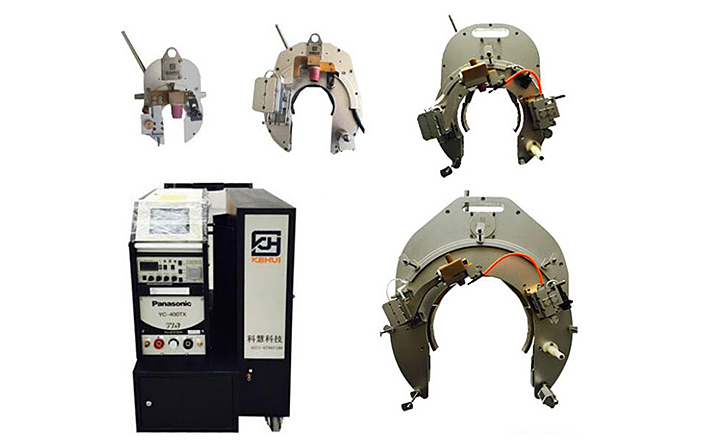
Our KHGK series is a classic open head orbital welding machine. It’s been our workhorse for three decades. Here’s where it shines.


Speed and Versatility


An open head orbital welding machine sets up fast. You clamp it, align it, and start welding. No sealing. No purge chamber to assemble. For pipe diameters from 1/2 inch to 8 inches, it’s the fastest orbital welding head to get running.

This makes the open head orbital welding machine the default choice for pipeline construction, process piping, and any job where you’re welding carbon steel or stainless steel with wall thickness above schedule 10. The exposed weld zone doesn’t hurt you because the material can tolerate minor oxidation, or you’re using proper purge on the inside.


Field-Friendly Design


When you’re working outdoors – on a pipeline right-of-way, at a construction site, or in a shipyard – the open head orbital welding machine is easier to manage. No fragile seals. No complex gas plumbing. Just clamp and weld.

We’ve sold open head orbital welding machine systems to contractors working in deserts, jungles, and Arctic conditions. The simplicity of the orbital welding head design means fewer things to break when the environment is trying to break everything.


When the Open Head Fails


But the open head orbital welding machine has limits. On thin-wall stainless steel – schedule 10 or thinner – the exposed weld zone allows oxygen to reach the root. The result is sugaring, oxidation, and loss of corrosion resistance. No amount of internal purge can fully protect the weld if the orbital welding head is letting air swirl around the outside.

For high-purity applications – pharmaceutical lines, semiconductor gas systems, food processing – the open head orbital welding machine is usually the wrong choice. That’s where the closed head orbital welding machine takes over.


What a Closed Head Orbital Welding Machine Does Differently


The closed head orbital welding machine encloses the entire weld zone inside a sealed chamber. The torch rotates inside that chamber. Inert gas floods the chamber before and during welding. The weld is completely isolated from the surrounding atmosphere.

Our KHGC series is our closed head orbital welding machine. It was designed specifically for thin-wall stainless and high-purity applications.


Perfect Gas Coverage


In a closed head orbital welding machine, there’s no debate about purge quality. The chamber is sealed. You flow argon (or a argon-hydrogen mix) until the oxygen level is below 50 ppm. Then you weld. The orbital welding head doesn’t care about drafts, shop airflow, or wind. The environment is controlled.

This is why the closed head orbital welding machine is standard for sanitary tubing. The welds come out silver or straw-colored – never blue or grey. No oxidation. No corrosion risk.


Consistency on Thin Wall


Thin-wall stainless (1.5mm to 3mm) is where the closed head orbital welding machine really proves itself. The sealed chamber maintains consistent thermal conditions. The orbital welding head doesn’t have to fight temperature variations from shop drafts. The result is a root that’s uniform around the entire circumference – no burn-through, no cold lap.

We’ve seen shops cut their rejection rate from 15% to under 2% just by switching from an open head orbital welding machine to a closed head orbital welding machine on thin-wall 304L.


When the Closed Head Is Overkill


But the closed head orbital welding machine isn’t always better. It’s slower to set up. The chamber needs to be sealed properly, which takes time. The orbital welding head is heavier. And on thick-wall pipe – schedule 40 and above – the sealed chamber doesn’t add enough value to justify the extra setup time.

For heavy-wall carbon steel or stainless, an open head orbital welding machine is faster and perfectly adequate. The closed head orbital welding machine is a specialized tool for thin-wall and high-purity work. Use it where it belongs, and it’s magic. Use it elsewhere, and it’s just extra work.


Key Differences Between Open and Closed Orbital Welding Heads

 
Feature Open Head Closed Head
Setup time Fast – clamp and go Slower – seal chamber, purge
Gas coverage Exposed to air; internal purge only Fully sealed; perfect coverage
Best for Thick wall, carbon steel, field work Thin wall, stainless, high-purity
Diameter range 1/2" to 8" (and larger with custom) Typically up to 4" or 6"
Weight Lighter Heavier (sealed chamber adds mass)
Oxidation risk Moderate to high on thin wall Near zero
Typical rejection rate (thin stainless) 10-15% Under 2%

Which orbital welding head is right for you depends entirely on what you weld most.


How to Choose the Right Orbital Welding Head for Your Shop


Here’s the decision framework we give customers who call us asking which orbital welding head to buy.


Choose an open head orbital welding machine if:


- You weld carbon steel or stainless steel with wall thickness ≥ schedule 40.
- You work in the field (pipelines, construction, shipyards).
- Speed of setup is more important than absolute weld perfection.
- You’re not welding high-purity applications (pharma, semiconductor, food).
- You need to cover a wide range of diameters (2" to 8" or more).

Our KHGK open head orbital welding machine is the right orbital welding head for most pipeline and process piping shops. It’s what we’ve sold to contractors on five continents for three decades.


Choose a closed head orbital welding machine if:


- You weld thin-wall stainless (schedule 10 or thinner).
- You work in high-purity industries (pharma, biotech, semiconductor, food).
- You need perfect root appearance with no oxidation.
- Your rejection rate on thin-wall stainless is currently too high.
- You’re willing to trade slower setup for better weld quality.

Our KHGC closed head orbital welding machine is the orbital welding head that turned around dozens of sanitary tubing shops. It’s not the fastest to set up, but it’s the most reliable for thin-wall stainless.


Choose both if:


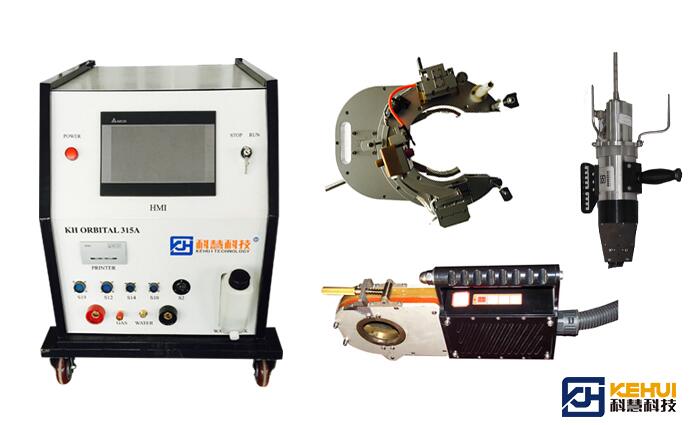
You do a mix of work. Many shops own both types of orbital welding heads and swap them as needed. Or they buy our KH-315A 3-in-1 system, which includes an open head orbital welding machine head (KHGK), a closed head orbital welding machine head (KHGC), and a tubesheet head (KHB12-80) – all running on one power source.

That’s the ultimate solution for fabricators who weld pipe-to-pipe one day and sanitary tubing the next.


What We’ve Learned About Orbital Welding Heads After 31 Years


We started building orbital welding heads in 1994. Back then, the open head was the only practical option. Closed heads existed, but they were expensive and finicky.

Over the years, we’ve improved both designs. Our open head orbital welding machine heads are now lighter, faster to align, and more tolerant of fit-up variation. Our closed head orbital welding machine heads are easier to seal, purge faster, and weigh less than they used to.

But the fundamental trade-off remains: open for speed and versatility, closed for purity and thin-wall consistency.

The best orbital welding head is the one that matches your application. Not the most expensive. Not the cheapest. The one that solves your actual problem.

We’ve helped customers in over fifty countries make this choice. We can help you too.


Ready to Choose Your Orbital Welding Head?


If you’re trying to decide between an open head orbital welding machine and a closed head orbital welding machine, start with your material and your environment.

- Thick wall, carbon steel, field work → open head (KHGK).
- Thin wall, stainless, high-purity → closed head (KHGC).
- Both, plus tubesheet work → KH-315A 3-in-1.

We’ll help you get it right. Call us. Tell us what you weld. We’ll recommend the orbital welding head – or heads – that fit your operation. We’ll send an engineer to your shop to train your people on your pipe. And we’ll be there when you need support.

Because after 31 years, we know that the best orbital welding heads aren’t just the ones we build – they’re the ones that work for you.

Latest updates

Related news

Recommend products

Zhengzhou Kehui Technology Co., Ltd

Email: info@zzkehui.com
Tel.:+86-0371-56576016
Mobile:+86-15633683072
Whatsapp: +86-15633683072
Address:High-tech and development Zone, Zhengzhou, Henan Prov.,China
+86 15633683072 +86 15633683072
Name:
Email:
Company:
Message: